
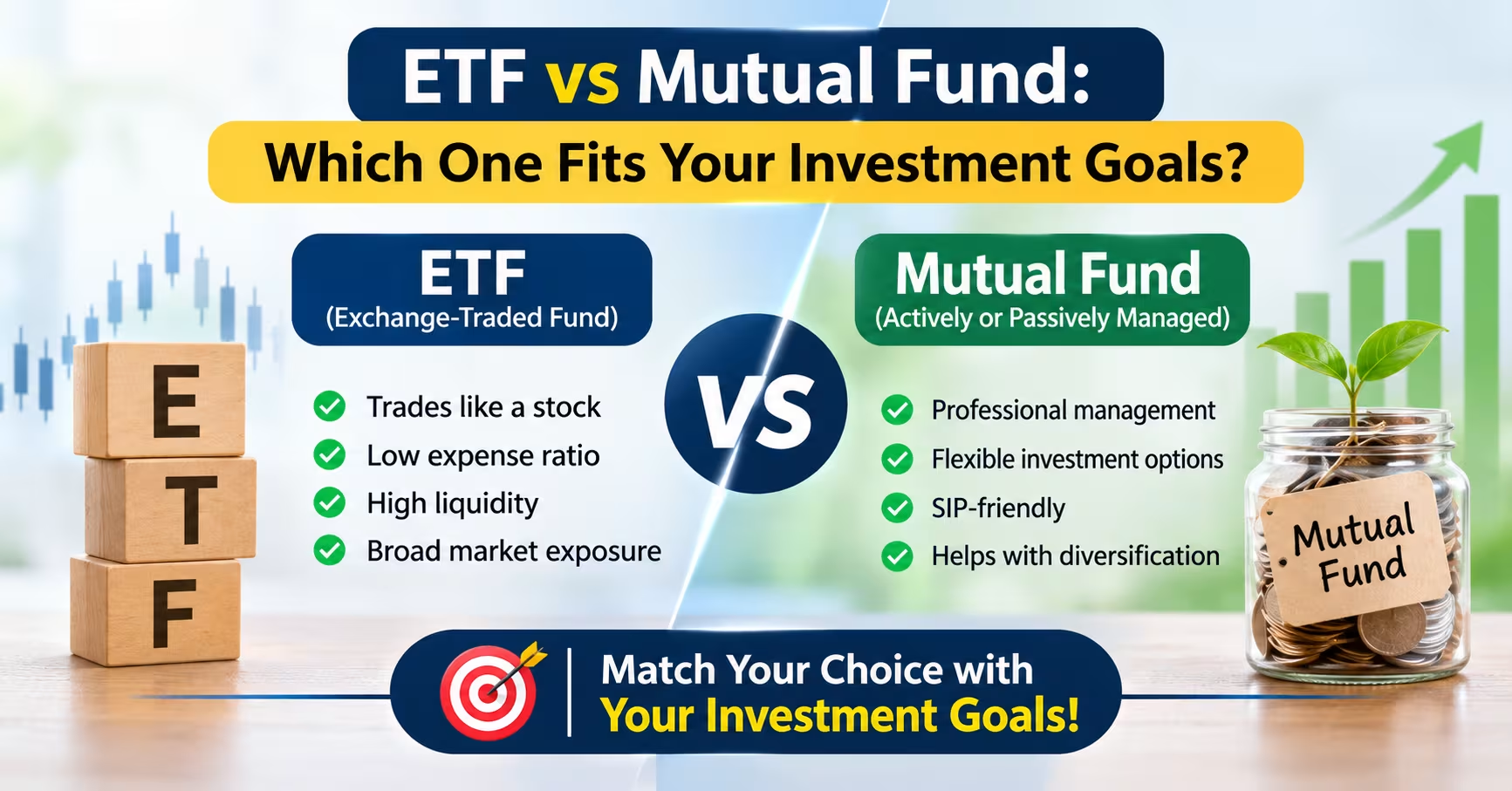
You will eventually have to make the choice between a mutual fund and an ETF when you're creating a portfolio. Pool the investment funds for many investors, or distribute them among stocks, bonds or gold, without having to select individual securities. However, they have a few differences in regard to how they are purchased, the charges, and the level of control you have over them. This guide will help you make your choice with confidence, as it outlines these differences.
What Is an ETF?
An exchange-traded fund (ETF) is a collection of stocks that is traded on a stock exchange like a stock. It is traded on the exchanges and subject to price fluctuation during the trading day, it can be purchased or sold at any time the market is open.
The majority of ETFs are of the passive variety. They are just a mirroring of an index like for example the Nifty 50, Sensex or Gold price. Since there is no stock picking done by a stock manager, running costs are generally low. Investors will require a demat and trading account with a broker.
What Is a Mutual Fund?
A mutual funds pool of money from several investors and a professional fund manager invests on the basis of a specific objective. Units are purchased and sold at the Net Asset Value (NAV) which is determined once a day at the close of trading.
Mutual funds are available in two types – active and passive. The goal of active funds is to outperform their benchmark, while the purpose of an index fund is to follow their benchmark. Investment can be made either in an AMC or through a distributor or an app and investing through a demat account is not necessary, making it easy to install a monthly Systematic Investment Plan (SIP).
ETF vs Mutual Fund: Key Differences
|
Feature |
ETF |
Mutual Fund |
|---|---|---|
|
Where you buy |
Stock exchange |
AMC, platform or app |
|
Pricing |
Live market price |
End-of-day NAV |
|
Management |
Mostly passive |
Active or passive |
|
Expense ratio |
Generally lower |
Varies; higher for active funds |
|
Account needed |
Demat and trading |
KYC-compliant account |
|
SIP |
Limited availability |
Widely available |
|
Minimum investment |
Price of one unit |
Often from ₹100 to ₹500 |
Not sure which suits you? The pros, cons and decision guide below will help you match your goals to the right option.
Trading and Pricing
You can trade ETFs at any point of the day. You'll receive the price, order it and receive the trade at that price. Mutual Funds are not traded intraday, meaning that the NAV of an order placed before the cut-off is the same. This may not be a significant factor for long-term buyers. For those who like to time entries, it does.
Costs and Expense Ratio
All funds have an annual fee. ETFs will typically have lower expense ratios as it only tracks an index. But there are brokerage and demat charges to be paid by ETF investors too, and a slight difference between the price at which an investor buys an ETF and sells it. The fees do differ in the case of mutual funds. Direct plans are less expensive than conventional plans as they do not include any distributor commission.
Management Style and Returns
The idea of an ETF is to closely replicate the index it represents, which means it will track the index with a very small tracking error. An actively managed mutual fund attempts to beat the market and while it may reward you if the fund manager is good, it harms you if not. Keep in mind that history doesn't repeat itself in either structure.
Taxation
The tax on the gains from both ETFs and mutual funds depends on the underlying asset—whether equity, debt or gold—and holding period. The rules remain unchanged, regardless of the structure. Tax regulations change over time; for up-to-date regulations please refer to the current regulations or please consult a tax advisor before investing.
Pros and Cons of Each Option
Advantages and Limitations of ETFs
Pros: low costs, transparent holdings, real-time trading and easy diversification across an index.
Cons: you need a demat account, some ETFs have low trading volumes that widen the price gap, and automating monthly investments can be harder.
Advantages and Limitations of Mutual Funds
Pros: simplicity of SIPs, professional management and wide range of schemes and low entry amounts.
Cons: Active funds have higher fees, the outcome is reliant on the fund manager and you can't day trade at your desired price.
How to Choose Between an ETF and a Mutual Fund
Consider your goal, time frame and risk tolerance before considering your habits.
-
If you're looking for the least amount of money to invest, and you don't mind having a trading account and prefer to buy based on the price that you see, then you can go with ETFs.
-
Invest in mutual funds if you wish to invest through automated SIPs, if you want to passivise your investments or if you are in search of an active management in a theme.
Your investing platform matters as well because the fees, interface and fund choices differ. For those who like to invest from their mobile phones, check out the features, charges and user-friendliness of the best mutual fund apps.
Can You Invest in Both?
Yes and many investors do. One of the popular strategies is to invest in low-cost Index ETFs as 'core', and purchase mutual funds with SIPs for active strategies, goal-based investing, mid-cap and small-cap stocks. This gives you the best of both worlds: ETFs are cheap, but are easier to use than mutual funds.
Final Thoughts
It's not a contest of "ETF" versus "mutual fund" and there is no one who could claim to be the outright victor. ETFs are ideal for investors who are willing to do self-trading and maintain a demat account, and do not focus on high costs. Mutual funds are ideal for investors who want to invest in SIPs that can be done automatically and want professional management and a passive approach to investing.
Align the product with the objective, monitor expenses and maintain the investment for the long haul. So, if you cannot decide, then prefer to use both together – ETFs for low cost and mutual fund SIPs for convenience.