
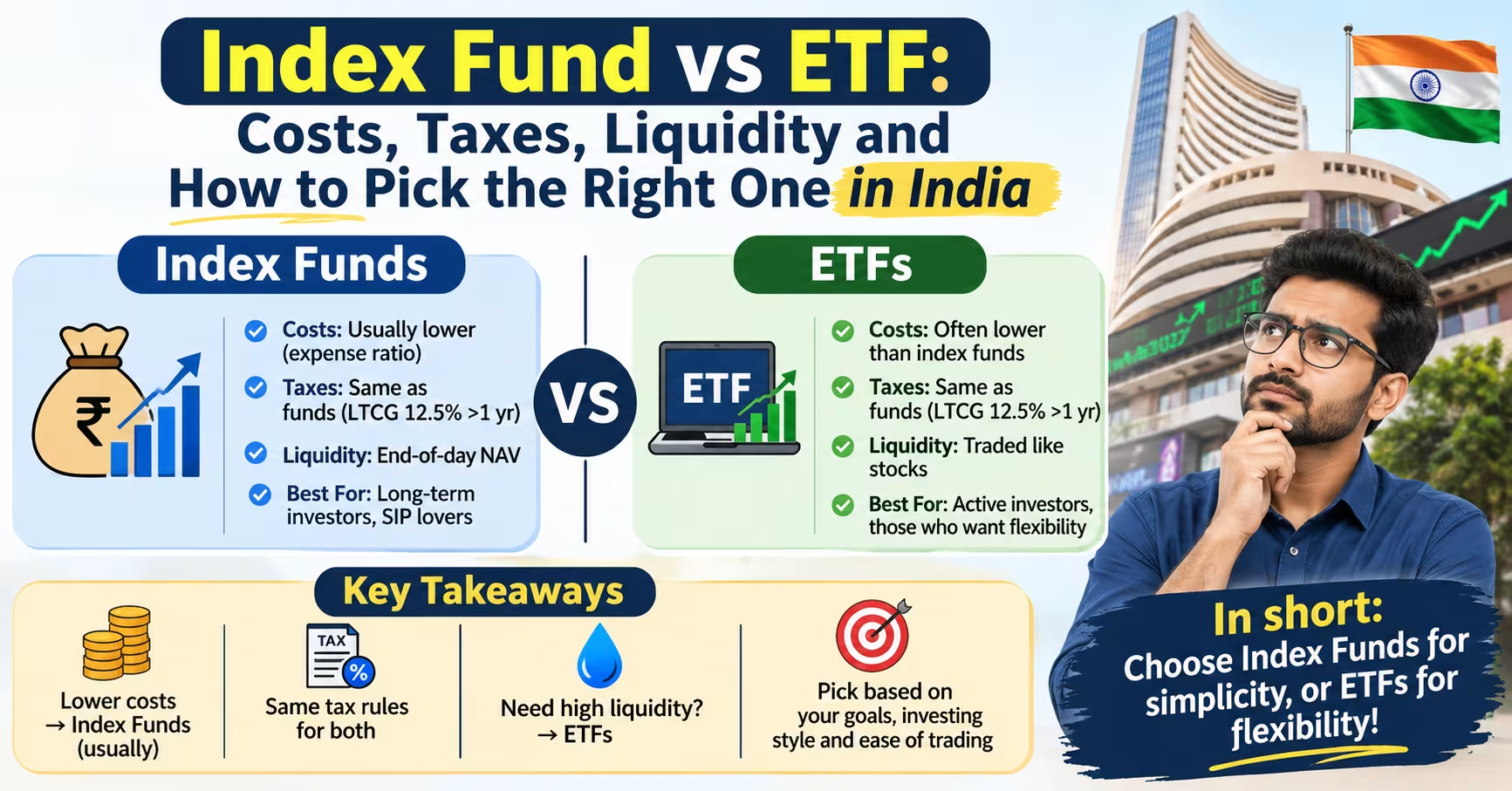
When it comes to providing easy, inexpensive exposure to the Nifty 50 or Sensex, you'll find two options that you'll be able to find quickly: index funds and exchange-traded funds (ETFs). Both are passive and both may be based on the same index. Where then are their differences? The index fund vs ETF debate boils down to how you purchase them, what the price is and what kind of control you desire. This guide provides a comparison of costs, taxes, liquidity and convenience, allowing you to choose the one that's right for you.
What Is an Index Fund?
How an Index Fund Works
An open ended fund that replicates a given index (like the Nifty 50) is called an index fund. It's designed to be following the same stocks in the same ratio as the index, so it will track the market it follows. The price at which you buy and sell units is the NAV as declared at the end of the day, either through an AMC website, a mutual fund app or through a distributor.
Key Features
-
No need of a demat account to open the trading account.
-
SIPs available and in many cases, even from very small monthly investments.
-
There are two types of plans: direct and regular plans and the direct plans are cheaper.
-
Units allocated at the day's NAV (not at your choice of price)
What Is an ETF?
How an ETF Works
Apart from this, an ETF also is a type of tracker that is listed on NSE and BSE and can be traded like a share. An order is placed via your broker, and when the market is trading you will purchase what you want at the current market rate. The market makers assist in maintaining the indicative NAV of the fund (iNAV) in close proximity to the market price.
Key Features
-
To open a demat account and trading account is a requirement.
-
Trading throughout the day using live prices.
-
Purchased whole grain products.Purchased whole grain products.
-
No matter what equity, gold, silver and debt you are looking at, you have options.
Index Fund vs ETF: Key Differences at a Glance
|
Factor |
Index Fund |
ETF |
|---|---|---|
|
Where you buy |
AMC or mutual fund app |
Stock exchange via broker |
|
Account needed |
Mutual fund account |
Demat and trading account |
|
Pricing |
End-of-day NAV |
Live market price |
|
SIP |
Built-in and easy |
Depends on your broker |
|
Expense ratio |
Usually slightly higher |
Usually lower |
|
Extra costs |
None on direct plans |
Brokerage and bid-ask spread |
|
Minimum investment |
Low, often a few hundred rupees |
Price of one unit |
Cost Comparison: Expense Ratio vs Hidden Charges
Expense Ratio
Although index funds are generally lower-cost than other ETFs that are similar to them. However, for popular indices like the Nifty 50, it could be a mere fraction of a per cent so do not make an assessment based on this number alone.
Brokerage and Spread
Brokers, statutory charges, and the difference between the buying price and the selling price (the bid-ask spread) are other fees that may be charged to ETF buyers. Typically, direct index funds don't impose any transaction fees. If you want to invest a little each month, the index fund is likely to be a cheaper overall investment. An ETF can outperform if you're making a big lump-sum investment through a low-brokerage account. It's not just the expense ratio, it's the total cost of ownership.
Tax Treatment in India
Taxes on equity-oriented index funds and equity index ETFs are similar. Under current rules:
-
If the duration is less than 12 months: STCG tax at 20% with indexation benefit.
-
If held for over 12 months: 12.5% of LTCG (at the rate of 12.5%, after applying the indexation benefit) will be applicable on the amount that exceeds ₹1.25 lakh per financial year.
There are different rules for gold, silver and products based on debt. Tax rates also fluctuate, so check with the Income Tax Department or a tax adviser before investing what the current rates are.
Liquidity and Tracking Error: What Most Guides Skip
Liquidity
An index fund will always be able to be redeemed with the fund house. Any ETF is reliant on the exchange's buyers and sellers. The popular ETFs trade more smoothly, but those that trade less frequently might have a significant spread and you will end up paying more for the purchase than the ETF may be worth. Prior to investing, review the daily volumes.
Tracking Error
Tracking error measures the error between a fund and its index. The lower the number, the better they are at their job. This is the reason two products with the same index may have slightly different returns; compare tracking error instead of past returns. You can find it on the fund's factsheet.
Index Fund vs ETF: Which One Should You Choose?
Choose an Index Fund If
-
You are new to the game and looking for simplicity!
-
You prefer to make automatic monthly SIPs.
-
You don't have a demat account:
-
You save small amounts on a regular basis.
Choose an ETF If
-
You have an existing demat account.You already have a Demat account.
-
You wish to purchase the product at the market price during market hours.
-
You make a bigger up-front investment but want to keep costs down.
-
You're looking for assets such as gold or silver that you want to be exposed to on the exchange.
Can You Hold Both?
Yes. Many investors invest in index funds SIP and invest in ETFs in a lump sum on a periodic basis. The same market risk is applied to both underpinnings. Both products don't cover you from market falls.
As a quick reference, do you wish for an automatic SIP? Select an index fund. Intraday pricing and Demat account?Looking for intraday pricing and having a demat account? Consider an ETF. Still unsure? Begin by investing in an index fund and then follow up with an ETF.
Final Thoughts
An index fund or ETF provides you with the same market exposure in a different package. If you are looking for convenience and simplicity, stick to an index fund; if you want to be more active when pricing your fund and have a lower running cost, then you might consider an ETF; compare tracking error and total charges before you invest. The more important issues over the long-term are the products chosen, and how often and for how long the investor buys them.
Looking to get started in investing in index funds or ETFs? You can compare the best stock brokers on TheTopStockBroker and open a demat account in no time.