
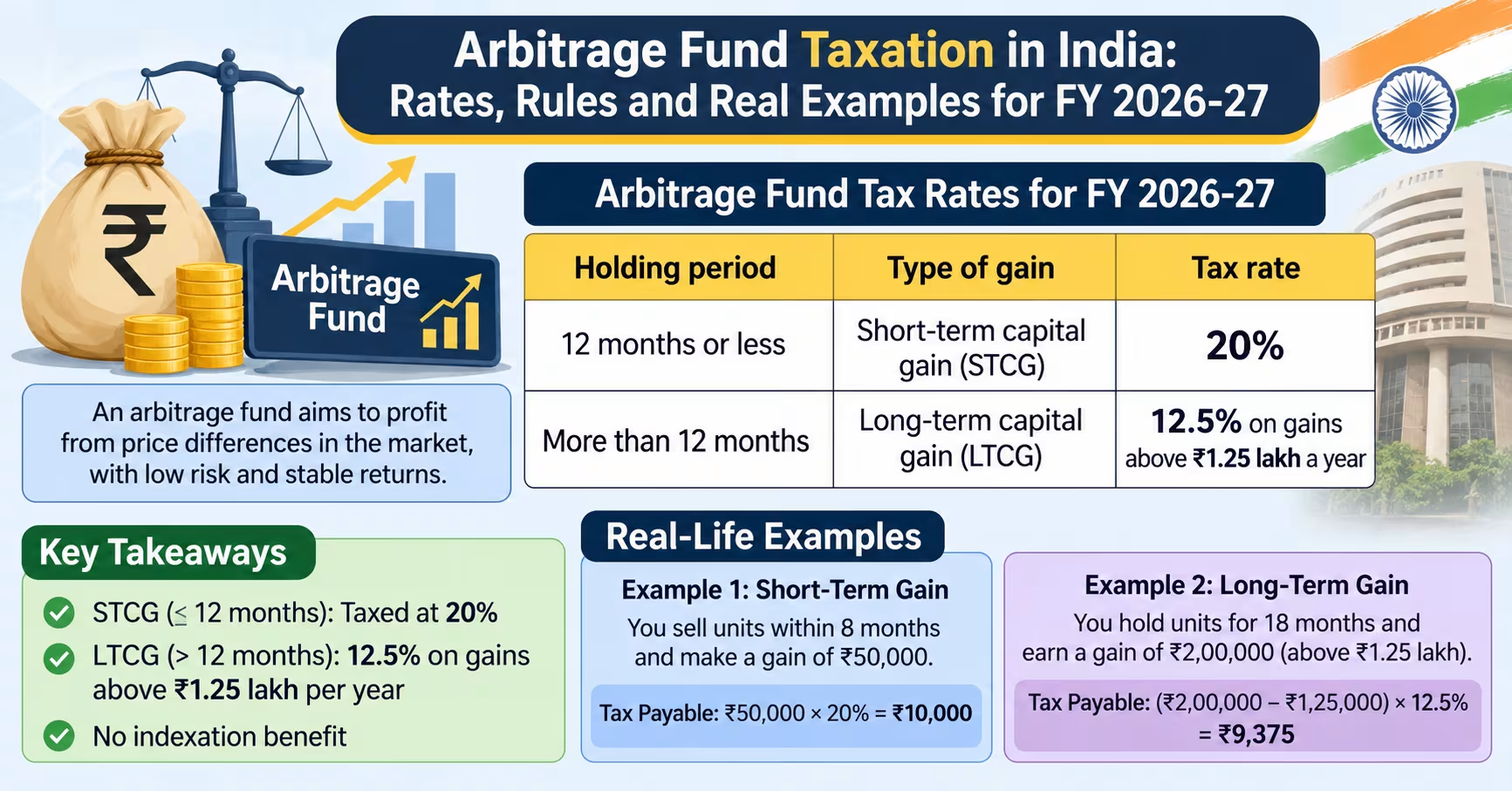
Arbitrage funds are similar to debt products, and provide small but fairly consistent returns based on the relative price difference between the cash market and futures market. But the tax department considers them as equity funds. One classification determines the percentage of your gain that you will actually retain. For FY 2026-27, short-term gains are taxed at 20% and long-term gains at 12.5% above ₹1.25 lakh a year. This guide includes an explanation of the rules, goes through all the numbers and illustrates when this treatment is truly beneficial.
Why Arbitrage Funds Are Taxed as Equity Funds
Tax law does not consider how risky a fund may feel and what they contain is the issue. Mutual funds are considered equity mutual funds if at least 65% of its funds are invested in equity shares of domestic companies. Arbitrage funds pass this bar because they buy shares in the cash market and then sell futures. Although the bulk of the market risk is eliminated, the shares remain in the portfolio, which qualifies the fund.
Tax applies when you redeem, not while you hold
The fund trades without the payers of taxes. Only if you redeem or switch units will you pay tax. Transferring funds within the fund will be considered a “sale” and could result in tax.
Arbitrage Fund Tax Rates for FY 2026-27
|
Holding period |
Type of gain |
Tax rate |
|---|---|---|
|
12 months or less |
Short-term capital gain (STCG) |
20% |
|
More than 12 months |
Long-term capital gain (LTCG) |
12.5% on gains above ₹1.25 lakh a year |
Short-term capital gains: 20%
The entire gain is taxed at a flat 20% if the units are sold within 12 months. This had been covered in the previous Income Tax Act by Section 111A.
Long-term capital gains: 12.5% above ₹1.25 lakh
The rate applicable to units with a longer holding period of more than 12 months is 12.5% (with no indexation benefit) and the first ₹1.25 lakh of long-term gains in a year are exempted (under the old Act at Section 112A). This exemption is available for all equity shares and equity oriented funds listed on your Portfolio. Not offered separately by each fund.
Surcharge and cess
The above rates do not include the 4% health and education cess and in addition, surcharge is applicable at higher incomes. These capital gains rates have remained as is in Budget 2026. The section numbers in the Income Tax Act 2025 (will be in operation from 1 April 2026) are replaced with the same numbers, but the tax rates are not altered. Also keep in mind that these special rate gains cannot be used for the Section 87A rebate.
Worked Examples: How Much Tax Will You Actually Pay?
Example 1: Selling within a year
Priya has invested ₹10 lakh in a scheme and redeemed it after eight months with a gain of ₹60,000. Her tax is 20% of ₹60,000, which is ₹12,000. With 4% cess, she pays about ₹12,480.
Example 2: Holding for more than a year
Rohan does not have any other long-term capital gains and his gain after 14 months is ₹20,0,000. His taxable gain, after giving effect to the ₹1.25 lakh exemption is ₹75,000. Tax at 12.5% is ₹9,375, or about ₹9,750 with cess. That represents just under 5% on his total profit.
Example 3: The same gain in a liquid fund
Say that an investor with a total income tax slab of 30% makes a ₹60,000 profit. If the money is invested in a liquid fund on which tax is levied at the slab rate, then the tax is ₹18,000 or approximately ₹18,720 with cess. It is approximately ₹12,480 in an arbitrage fund that is held for less than a year. This means you can save about ₹6,240 before taking into consideration returns for the funds themselves.
Other Tax Rules Investors Often Miss
-
Loss set-off: These could be short-term capital losses that can be set-off against either short-term or long-term gains. Only a long term loss can offset a long term gain. Unused losses can be carried forward for eight years if you file your return on time.
-
FIFO method: If part of a holding is sold, the first units in the holding are considered sold first. The units will then be considered "in your hands" from that time.
-
IDCW Option: If you choose this option, then dividends received under this option will be treated as income and taxed at your slab rate. The growth option is typically a simpler tax.
-
NRIs: The rates of capital gains remain the same, but normal tax will be deducted at source on redemption of units. These gains typically aren't subject to TDS for residents.
-
Capital Gains - any capital gains should be reported on your income tax return. Fill it in with information from the capital gains statement from your fund house or registrar.
Arbitrage Fund vs Liquid Fund: Tax Comparison
|
Feature |
Arbitrage fund |
Liquid fund |
|---|---|---|
|
Tax on gains within 12 months |
20% |
Slab rate |
|
Tax on gains after 12 months |
12.5% above ₹1.25 lakh |
Slab rate |
|
Annual exemption |
₹1.25 lakh (long-term, shared) |
None |
|
Tax advantage greatest for |
Higher slabs (20–30%) |
Lower slabs |
Tax Efficiency is based on your slab. Under equity taxation, the investor saves a lot if he is in the 30% slab. A person belonging to the 5th/10th slab might end up paying even less on a short term liquid fund gain than the flat 20%. Remember that the increase in securities transaction tax, following Budget 2026, has increased the cost of arbitrage, so consider the returns, after tax, not just the tax rate.
Who Benefits Most from Arbitrage Fund Taxation?
The equity tax treatment is most beneficial for investors who fall in higher tax rates, investors who plan to keep the investment for more than 12 months, investors who desire the advantage of annual exemption of ₹1.25 lakh. The 20% flat rate might not be as beneficial if the money is needed within a couple of weeks.
Conclusion
Arbitrage funds merge the low volatility along with the equity tax regime: 20% for short-term gains and 12.5% above ₹1.25 lakh for long-term gains. The benefit is your way if the product is held for more than a year and is in a higher slab tilt. When investing, always compare post-tax returns, expense ratios/loads before investing and consult a tax professional regarding your individual situation. Ready to invest? Make a comparison among the top brokers and open a TheTopStockBroker demat account now.
Tax rules change. This is general information, not tax advice. Mutual fund investments are subject to market risks. Read all scheme-related documents carefully.