
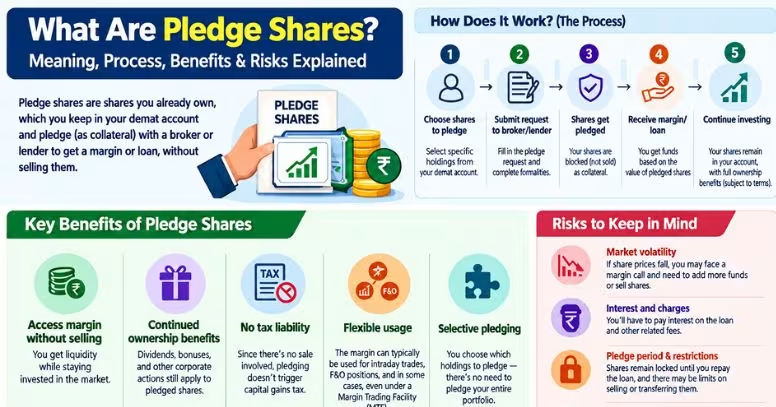
Suppose you find a nice intraday trade or are looking to open a new trade in futures and options, but you don't have enough funds in your trading account. Selling your long-term stock holdings to cash in isn't the best idea because you would lose out on any possible future profits, and you also would incur unnecessary expenses. That's where pledging shares comes into the picture. It allows you to get the most out of your existing investments, and not have to sell any stocks in your portfolio. This guide explains what pledge shares are, how they work, their benefits and drawbacks and how they compare to other margin facilities. Facilities such as thetopstockbroker can also allow you to compare brokers to funding percent and fees before you make your decision on where to pledge.
What Does It Mean to Pledge Shares?
The only problem with pledging shares is that you give over the stocks or ETFs that you already hold as collateral to your broker for the purpose of trading with margin. You don't sell the shares, you do not have the right to sell the shares during this period of time, and in exchange the broker deposits the useable margin into your account according to the value of the shares.
If your demat account has ₹1,00,000 worth of stocks, for instance, you could pledge them and receive a margin amount, which is less than the value of the stocks (subtracted by a process known as haircut), to enable you to open new trades.
How Is Pledging Different From Selling Shares?
Whereas, selling causes a taxable event, pledging does not and the dividends and other corporate benefits on the pledged shares remain. The only “hard” limit is that you cannot sell those shares until the pledge is removed.
How Does the Share Pledging Process Work?
Today it is much of a digital process and there is no paperwork involved. Let's take a quick look at a simple flow:
-
You choose the shares/ETFs in your demat account which are eligible to pledge.
-
Your steward raises a pledge request in your app/platform.
-
Authorization of the request is made by sending OTP from depository (CDSL/NSDL).
-
If approved, the margin will be credited to your trading account, less a haircut as may be required.
SEBI has imposed more stringent norms for pledge and re-pledge in 2020 to ensure transparency and safeguard the investor's interests and investment from misuses and mishandling.
What Is a Haircut in Share Pledging?
A haircut is the percentage that is deducted from the market value of your stocks to obtain the "usable margin". It is in existence because the price of shares changes and the brokers require a safety margin against that risk. If a stock is stable with a large cap, the haircut will be lower than if the stock is volatile and has a smaller cap, which means that you will get a higher percentage of the value of the shares as margin.
Eligible Securities for Pledging
Not all the stocks in your portfolio can be pledged. Typically, brokers have an approved list of equities and ETFs that are eligible for trading, which is determined by liquidity and volatility requirements. This is a worthwhile consideration before deciding a holding is fit for a particular purpose.
Benefits of Pledging Shares
There are some practical benefits to pledging for an active trader/investor:
-
Access margin without selling: You get liquidity while staying invested in the market.
-
Continued ownership benefits: Dividends, bonuses, and other corporate actions still apply to pledged shares.
-
No tax liability: Since there's no sale involved, pledging doesn't trigger capital gains tax.
-
Flexible usage: The margin can typically be used for intraday trades, F&O positions, and in some cases, even under a Margin Trading Facility (MTF).
-
Selective pledging: You choose which holdings to pledge — there's no need to pledge your entire portfolio.
Funding percentages, haircuts and charges do vary significantly from broker to broker, so it is best to shop around a bit before investing. A tool such as thetopstockbroker can come in handy here, and help you determine which brokerage provides the best margin, lowest haircut and least pledge-related fees.
Risks and Charges Involved in Pledging Shares
Placing shares in a margin-based facility is never without risk, like all forms of margin facilities.
Margin Calls and Forced Selling
Should the share price fall in the market, the amount of margin available will decrease as well. This can result in an increase in a margin call, therefore you have to tip in more money or extra safety. The broker may sell the shares pledged to make up the shortfall if you can't cover the amount, and he or she can do so at a price you might not have chosen.
Pledge and Unpledge Charges
Most brokers charge a fee upon unpledging (usually a flat fee per instruction or per security), whereas many brokers do not charge anything to pledge. Also, if the margin you use is above the limit that is provided where there is no interest, you may be subject to interest on the margin used that goes above that limit. They vary from broker to broker and it's important to read the small print.
How to Unpledge Shares
The opposite of unpledging is what?What is the opposite of unpledging? When you have paid back or no longer require the margin that you used, you can make an unpledge request via your broker's site. The restriction of the shares will be removed after processing and you will become the full seller or transferor of the shares.
Pledge Shares vs. Margin Trading Facility (MTF): What's the Difference?
While there is a potential for confusion between these two, they have different roles:
Pledge Shares: These are the shares that you pledge to get margin for other trades.
MTF: The broker makes a new buy of shares, and the new shares purchased are pledged as collateral for the loan made.
To sum up, pledging is an option that involves using your existing assets, whereas MTF is an option that enables you to purchase additional assets that you wouldn't otherwise be able to afford.
Also Read:Top 10 Stock Brokers in India for 2026: Key Features and Review Comparison
Is Pledging Shares a Good Idea?
Pledging shares can be a good option to release the liquidity for short-term trading requirements, without affecting long-term investments. It is suitable for active traders who can keep an eye on margin requirements and swiftly adjust to the market's fluctuations. But if you don't want to watch margin calls and deal with volatility, you may want to tread lightly on this feature.
Need to look into the possibilities? Use thetopstockbroker and compare the funding percentage, haircut and charges offered by brokers, and select one that allows you to pledge your shares with ease and is cost-effective.