
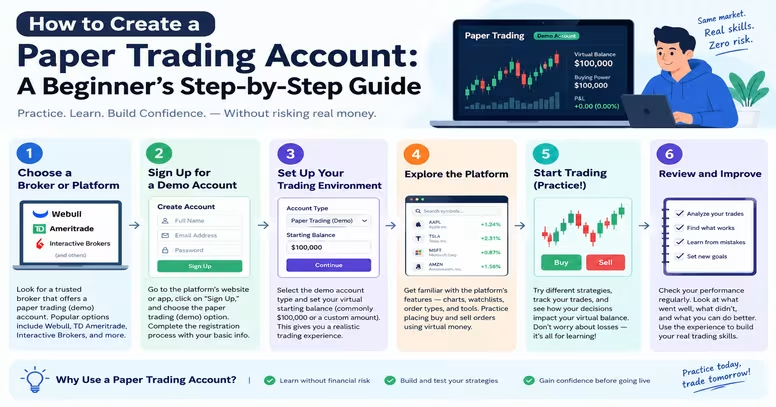
Most stock market novices discover the stock market the costly way: by dropping real cash. Paper trading is a more intelligent way. Creating a paper trading account is a 5-step, 5-minute process, and it's quite simple. Nowadays, simulators, often called a paper trading app, have adopted the digital method and display real market prices
What Is a Paper Trading Account?
A paper trading account is a practice account that lets you buy and sell securities using virtual money. The name comes from the old habit of tracking imaginary trades on paper. Nowadays, simulators, often called a paper trading app, have adopted the digital method and display real market prices
How Paper Trading Works
You receive a virtual balance, such as ₹10,00,00. You then go on to make the same buy and sell orders as you would in a real account. The prices are based on the real market, which means that the profits and losses are a reflection of the strategy's performance, with no monetary risk.
Paper Trading vs Live Trading
|
Factor |
Paper Trading |
Live Trading |
|---|---|---|
|
Money at risk |
None (virtual) |
Real capital |
|
Emotional pressure |
Low |
High |
|
Cost |
Usually free |
Brokerage and taxes apply |
|
Best for |
Learning and testing |
Earning and investing |
The only difference is emotion. When it doesn't actually cost any money, fear and greed don't tend to appear, so use paper results as a guideline, not a promise.
Benefits of Opening a Paper Trading Account
Learn Without Risking Capital
You can go wrong and purchase it at the incorrect time, or forget to take advantage of a stop loss, and still pay nothing for that lesson.
Test Strategies and Build Confidence
Looking for a swing trading, day trading or a moving-average approach? A virtual trading account is the place you can attempt a thought numerous times without risking a rupee or dollar.
Understand Platform Features Before Going Live
It can seem daunting at first to use order types, charts, watch lists and alerts. With a demo trading account, you avoid the costly button-clicking mistakes later on.
How to Create a Paper Trading Account in 5 Steps
To get started, do as follows:
-
Select a trustworthy paper trading site
-
In order to register, you must provide the basic information.
-
Verify your account
-
Invest your virtual money
-
While this kind of trading is still in its infancy, there is a first time for everything.
Step 1: Choose a Reliable Paper Trading Platform
There are two options, one is a broker that provides a simulator and one is another third party stock market simulator app. The greatest benefit of brokers' simulators is that the interface is similar to the one you'll use once you're ready to play the real game. Before making a decision, check the TopStockBroker options.
Step 2: Sign Up with Your Basic Details
Type in your name, email address or phone number and set up a password. Typically, demo accounts will not require extensive KYC information since there is no real money involved, but a few brokers might request basic information.
Step 3: Verify Your Account
Verify email or enter OTP (One Time Password) sent to your mobile. After verification you are able to log on to the platform.
Step 4: Set Your Virtual Capital
Choose a seed amount. Pick a figure that's similar to the amount you would actually invest. Doing an unrealistic ₹1 crore can help inculcate sub-optimal trade habits like taking big trades which one can't afford in real life.
Step 5: Place Your First Practice Trade
Find a stock, select if you will buy it at a market price or a limit price, indicate the number of stocks you will be purchasing, and the stop price. Place the order and then monitor the performance of the order in your portfolio and trading history.
Looking for a platform to choose from? To see TheTopStockBroker's Best Broker Picks, click this link.
What to Look for in a Paper Trading Platform
All simulators are not created equal. To make an informed decision, you should look out for:
-
Real-time or near-real-time data, so your practice reflects the actual market
-
Multiple asset classes, such as stocks, F&O, forex or crypto, depending on your interest
-
Performance analytics and trade history to review what worked
-
A mobile app and charting tools for practice on the go
-
A smooth path to a live account, so you can switch without relearning everything
Tips to Get the Most Out of Paper Trading
Treat Virtual Money Like Real Money
Play by your own set of rules. Don't risk 40% of your capital on one trade here, if you wouldn't do so in real life.
Keep a Trading Journal
Record the reason for entering the trade, your target, your stop loss and what you got. Over the course of several weeks, patterns of errors will become evident.
Know When You're Ready to Go Live
Two to three months of consistent results, and disciplined risk management, is a good indicator. Upon arrival, start trading live with a small amount.
Common Mistakes to Avoid
Over-leveraging: borrowing too much for virtual positions, that you wouldn't have been able to afford in real life.
Lack of awareness of risk management: failure to take stop-losses as they are practice only.
Risk management ignorance: not taking stop-losses as practice;
One early success does not make a successful strategy: but a few wins can happen too early to make it a winning idea.
Conclusion
Learning how to create a paper trading account is simple: pick a platform, sign up, verify, set your virtual capital and place your first trade. If played responsibly, it will teach the skills and discipline that are necessary before playing for real money. You need to practice consistently, know your trades and then start trading live when it's right for you.