
When investors start trading they only care about demat charges twice — when they see that the tiny amount of deduction is missing from their trading ledger and they don't have an explanation for it in the contract note. The reality is that a Demat account is not a one stop shop product. There are multiple layer charges, some of which are set by the depository, some set by the broker/bank (your Depository Participant, or DP) and some added by the government in the form of tax. Knowing in advance what charges are involved with a demat account can help you avoid any shocks and choose a company that caters to your preferred investment strategy.
In this guide, you will see all the common demat charges, understand the entity that imposes them and the ways you can save on them.
What Are Demat Account Charges?
Demat account charges refer to the various fees you pay to open, maintain, and transact through your dematerialised (electronic) securities account. Unlike brokerage, which is charged per trade, most demat charges are tied to holding the account itself or moving securities in and out of it. Platforms like TheTopStockBroker help you compare these charges across brokers, making it easier to pick a demat account that fits your investment needs.
Who Levies Demat Charges — Depository vs DP vs Government
It's as though there are 3 layers:
-
The Depository (NSDL or CDSL): These are the two entities that actually hold your securities electronically. They charge a small base fee to your DP for certain services.
-
The DP (your broker or bank): Your DP passes on the depository's charge and typically adds its own markup on top.
-
The Government: GST is applied to most service-related charges, though not to the value of the securities themselves.
Types of Demat Account Charges
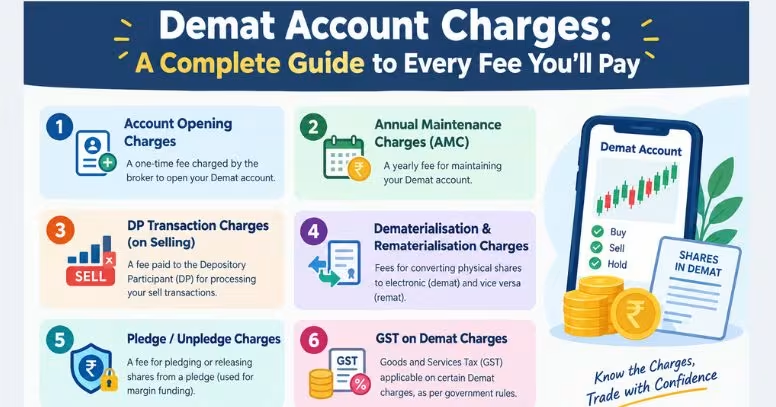
Account Opening Charges
Certain brokers require a single-up fee for opening a demat account, but a few discount brokers and full-service firms have started to give away account opening for getting new customers. This fee (if applicable) is typically for KYC verification and administrative setup.
Annual Maintenance Charges (AMC)
An annual or quarterly charge made by your DP to maintain your account is called the AMC. It is not dependent on the number of trades made, it's just the expense of maintaining the account. There is wide variation in the amount of AMC among different DPs and some do not even impose AMC in the first year as an incentive for the broker to join, but implement it at the standard rate from year two onwards.
DP Transaction Charges (on Selling)
This is one of the demat charges that are misunderstood. Each time a share is being sold, a small charge is deducted from the sale of the shares from your demat. It's charged per stock and per day — that is, the same DP charge is levied on each sale of a stock, whether that's one or a thousand, on the same day. Notably, this charge in addition to brokerage, meaning that even if you use a ‘zero brokerage' broker, you will still have to pay a DP charge when you sell.
Dematerialisation & Rematerialisation Charges
Dematerialisation refers to the conversion of a paper share certificate into its electronic equivalent and rematerialisation is the opposite. These are charges which are applied once and for the event — most investors who have traded electronically just once will never see these charges. They will normally be charged by the certificate and can mount up when you're converting large numbers of old paper shares.
Pledge / Unpledge Charges
In case of pledging assets on margin, both the depository and the DP levy are charged with small fees on pledging and releasing the assets. It's important for frequent margin traders to consider this in their trading expenses as both sides of the pledge cycle come with a price tag.
GST on Demat Charges
The current tax rate of 18% under the Goods and Services Tax (GST) regime covers nearly all of the charges collected by various Depository Participants (DP) for demat transactions such as AMC, DP transaction charges, pledge charges, and demat charges. It does not affect the worth of securities you purchase or sell or related charges, such as Securities Transaction Tax (STT) or stamp duty, which are different taxes levied by government.
BSDA vs Regular Demat Account Charges
Who Is Eligible for a BSDA
Basic Services Demat Account (BSDA): An account that was created by the Securities and Exchange Board of India for the benefit of small investors. You need to have only one demat account and be the first or only holder with the total securities being the sum of the securities locked in one's demat account being less than a certain threshold set by SEBI.
How BSDA Lowers Your AMC
SEBI capped AMC slabs often at 0 till a certain holding value and capped moderate amount thereafter are a boon to BSDA accounts. In the case of investors with a smaller portfolio, this makes BSDA a wise option as it virtually eliminates one of the most significant de-mat recurring costs.
Hidden Demat Charges Investors Often Miss
Zero Brokerage Doesn't Mean Zero DP Charges
Many investors may think that a 0-brokerage broker means there's no cost when it comes time to sell. In fact the DP transaction charge is still payable, and not a separate line item on your funds ledger as it is a contract note.
Dormant Account Charges
The AMC is not deducted from a demat account that isn't used or remembered. If left unpaid, these charges can get into arrears and some DPs may even close the account due to failure to pay.
Physical Statement Charges
Electronic statements are complimentary and a request for a printed/mailed statement typically involves a small fee.
How to Reduce Your Demat Account Charges
-
Determine eligibility for BSDA and enroll if you are eligible
-
When creating a new account, check the difference between AMC and opening charges prior to opening an account with a DP.
-
Prevent redundant and unnecessary certificate conversions, if possible
-
Having all your holdings in one demat account makes it easier to be eligible and keep track of holdings.
Demat Charges Comparison at a Glance
To help the investors, the chart below provides a quick look at the demat charges.
|
Charge |
Who Levies It |
When It Applies |
|---|---|---|
|
Account Opening |
DP |
One-time, at account creation |
|
AMC |
DP |
Annually or quarterly |
|
DP Transaction Charge |
Depository + DP |
Per stock, per sell day |
|
Dematerialisation |
DP |
Per physical certificate converted |
|
Pledge / Unpledge |
Depository + DP |
Per pledge instruction |
|
GST |
Government |
18% on most service charges |
You May Also Like:Best Demat Accounts in India (2026): A Complete Guide for Investors
Conclusion
At the first sight, the charges may look confusing, but it can be broken down into small segments: The depository fixes a base charge, the DP charges a markup, and most service charges are subject to GST. Understand this structure, and check if a BSDA is working in your favour and you can compare with confidence and avoid unpleasant surprises on your statement.
Note: Specific fee amounts (AMC, DP charges, opening fees) change periodically across brokers and depositories — verify current rates from official broker/depository sources before publishing final figures.