
Two investors invest the same amount of money in the same mutual fund, each month. 20 years later one of them is lakhs of rupees richer. It's not about luck or timing! It boils down to one small decision on Day One – regular vs direct mutual fund.
In case of SIPs, this option has the largest impact on your corpus than most people are aware of. At thetopstockbroker, we know that a clear explanation is better than one that is complicated. So here's what you need to know.
What Are Regular and Direct Mutual Fund Plans?
All mutual funds are offered in two schemes in India. They share the same holdings in stocks and bonds, and have the same fund manager. It's just a matter of the way you purchase it and the price.
What Is a Regular Plan?
A regular plan involves investing through a distributor, a broker or a bank. The intermediary gets a commission from the fund house for bringing you in and servicing you. That's what they charge you in the commission—it gets integrated into the expense ratio of the fund and you are charged the commission indirectly, year after year.
What is a Direct Plan?
With a direct plan, you invest directly with the fund house (AMC) either online or via any platform which provides direct plans. There is no distributor in the middle, no commission is paid! On 1st January 2013, SEBI provided an alternative to investors by launching direct plans, which offered a cheaper alternative.
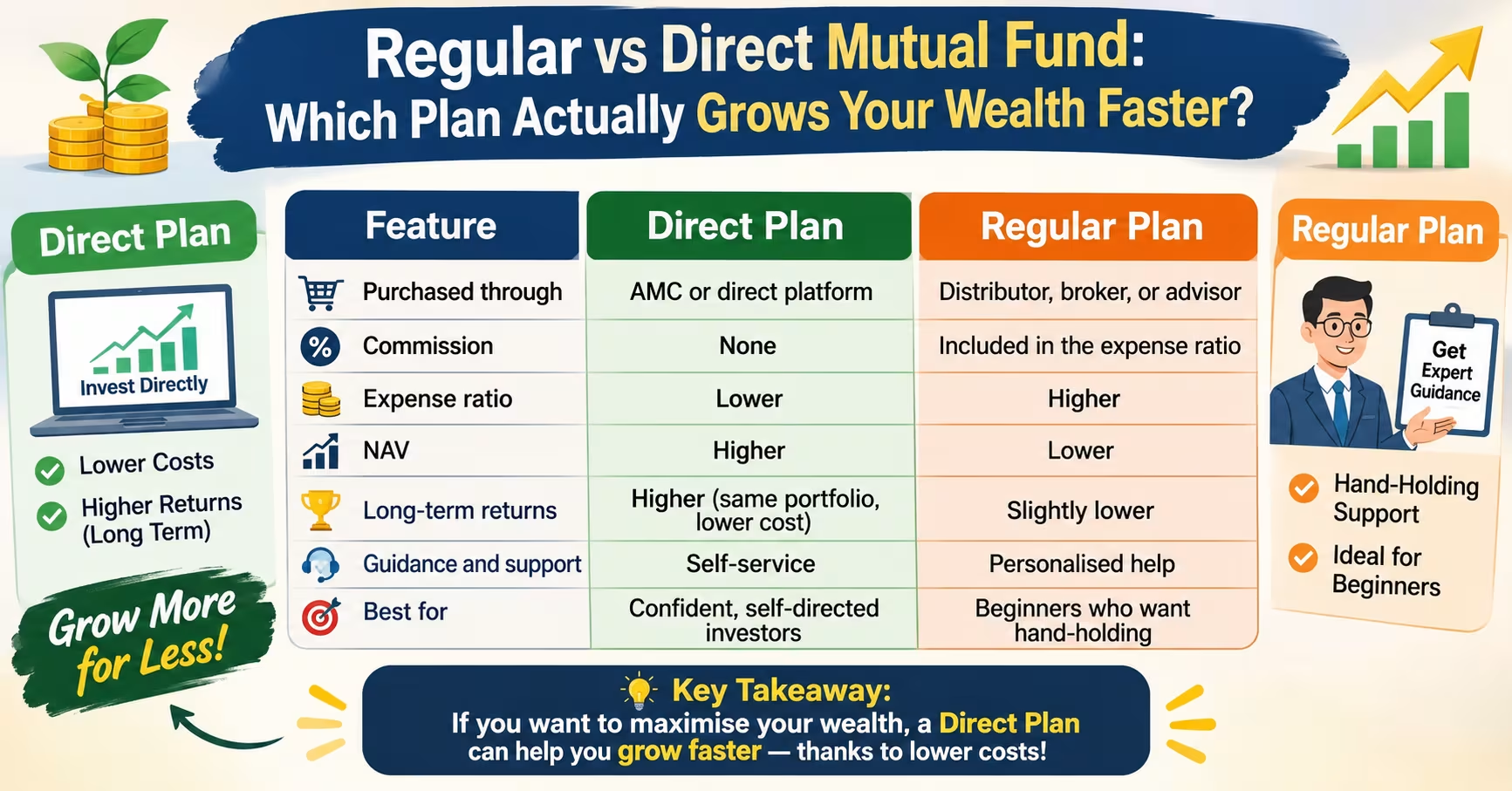
Direct vs Regular Mutual Fund: Key Differences at a Glance
|
Feature |
Direct Plan |
Regular Plan |
|---|---|---|
|
Purchased through |
AMC or direct platform |
Distributor, broker, or advisor |
|
Commission |
None |
Included in the expense ratio |
|
Expense ratio |
Lower |
Higher |
|
NAV |
Higher |
Lower |
|
Long-term returns |
Higher (same portfolio, lower cost) |
Slightly lower |
|
Guidance and support |
Self-service |
Personalised help |
|
Best for |
Confident, self-directed investors |
Beginners who want hand-holding |
Remember that the portfolio is identical in both. A direct plan doesn’t pick better stocks; it simply costs less to hold.
How the Expense Ratio Changes Your Returns
The annual fee that a fund charges, before you get any returns from it, is its expense ratio. A regular plan’s ratio is typically higher than the direct plan’s because of the commission. The gap may seem small on paper but can rapidly grow into a big gap.
Use an example to illustrate. You put ₹10,000 per month into an investment for 20 years.
-
Direct plan (assume 12% annual return): about ₹99.9 lakh
-
Regular plan (assume 11% annual return, a 1% higher expense ratio): about ₹87.4 lakh
However, this is about ₹12.5 lakh, despite putting in the same amount of money in the same fund. The lesson is true, although these numbers are merely illustrative and will depend on the market, small expenses over decades add up to a loss of wealth.
Advantages and Disadvantages of Each Plan
Direct Plans: Pros and Cons
Pros: Lower costs, higher NAV, and better compounding over the long term. You also have complete control on your investments.
Cons:It takes all of the effort from you, from choosing the funds to tracking performance, rebalancing, and paperwork. You also don't have any sort of safety net when the markets start to tumble.
Regular Plans: Pros and Cons
Pros: You get help with choosing funds, completing KYC, and staying invested. For nervous beginners, a good advisor can prevent costly mistakes like panic-selling.
Cons: You pay more every year. There is also a possible conflict of interest, since some distributors may lean toward funds that pay higher commissions.
Which One Should You Choose?
There is no one clear winner. It's up to you to decide the right plan.
If you select a Direct Plan:
-
You're at ease in doing your fund research and comparing schemes.
-
You know your level of tolerance for risk and how to allocate your assets.
-
It's possible to remain disciplined in volatile markets.
-
You want to have each and every rupee work for you.
If you would like to choose a Regular Plan, select it.
-
You are a beginner investor and daunted with the prospect of investing.
-
You would like someone to help you make choices and answer questions.
-
You consider support and discipline more important than cost saving.
Remember that the true benefit of an advisor is that they do not choose funds, they keep you in them! When paying for that guidance, you want to be sure you're receiving it.
Can You Switch from Regular to Direct?
Yes, but there isn't a “convert” button. Switching involves converting your standard units back to cash and then purchasing units in the direct plan of a like scheme. This may lead to exit load and capital gain tax in accordance with the units' holding period and capital gain.
Switching should only be done if you are holding the position and the tax cost is estimated. If you have a larger portfolio, consult your tax professional. One of the best things that you can do is to start each new SIP in the direct plan and carefully examine the old SIPs.
Want to Earn from Mutual Fund Advice?
Those who like to assist others understand finance may well have a money career. Discover what makes you a mutual fund advisor and what steps you can take to guide your investors to their financial journey.
Final Thoughts
The cost vs convenience comparison is the one that makes the difference between regular vs direct mutual funds. For the investor willing to learn and do things on his own, direct plans are the best, while for the one who requires a steady hand, regular plans are the right thing. Neither is “wrong”. The important thing is to choose the one you will be able to continue for the long term.
Not certain by which means to start? Visit the topstockbroker and get started with investing in SIPs.
Disclaimer: Mutual Funds investments are at risk. Thoroughly read all scheme related documents. The figures shown are indicative and not a guarantee of returns.