
All the mutual funds schemes in India are available in two types: Regular plan and Direct plan. While many investors don't really see the distinction, it can make a huge difference in the amount of wealth they accumulate over many years. So, if you have ever wondered what direct mutual funds are and if they are for you, this article will help you understand the meaning of direct funds, its benefits, risks, and the steps to start investing in direct funds. We at TheTopStockBroker assist investors in finding the perfect platform to invest in and make informed decisions, so let's start with the basics.
What Are Direct Mutual Funds?
Direct mutual funds are plans that you purchase directly from the fund house (the AMC), or from a platform that provides direct plans, without having to go through a distributor, broker or agent. Since there is no middleman, there is no distribution commission. From 1st January 2013 SEBI launched direct plans for all the schemes, so there are plans for almost every mutual fund.
What is key is that a direct plan and a regular plan for the same scheme contains the same portfolio, have the same strategy and are managed by the same fund manager. The only difference is in the cost.
Direct vs Regular Mutual Funds: Key Differences
|
Feature |
Direct Plan |
Regular Plan |
|---|---|---|
|
Distributor commission |
None |
Included in the cost |
|
Expense ratio |
Lower |
Higher |
|
NAV |
Grows faster over time |
Grows slower over time |
|
Advice and support |
Self-guided |
Provided by the distributor |
|
Best suited for |
Self-directed investors |
Investors who want hand-holding |
How Direct Mutual Funds Work
The standard plan provides the AMC a commission, which is incorporated into the plan's expense ratio. This commission is not applicable in a direct plan, making the cost ratio less in that case. This saved amount remains invested in the plan and the NAV of the plan compounds a bit faster every year.
The difference in the two NAVs might appear to be small for one year, but can add up over time. However, if you are yet to get the hang of it, it would be helpful to start from the basics of mutual funds in India before putting your money to work; our beginner's guide to mutual funds in India is a great place to begin.
Benefits of Direct Mutual Funds
Lower Expense Ratio
The annual fee charged by the fund to manage your money. Direct plans do not involve the commission, thus incur lesser charges, and all the money saved from these fees remains in the corpus.
Higher Long-Term Returns
The little difference in cost adds up to a lot of money. The following is an example of this. Now, assume that you invest ₹10,000 per month in a SIP for 15 years, and the SIP that is normal gets a 11% annual return while the direct investment plan gets a 12% annual return due to its lower fees. The investment in either is ₹18 lakh but the regular plan increases to around ₹46 lakh and direct plan to around ₹50 lakh. This is a difference of approximately ₹4.5 lakh. It is a representation and not a promise – and actual returns will be dependent on market performance.
Transparency and Control
A direct plan involves you in choosing the plan you want to purchase, when you want to purchase it, and when you want to leave it. You will also get to see exactly what you are paying, and you will not be charged any commission.
Drawbacks of Direct Mutual Funds
Choosing the Right Scheme Is Your Job
There are hundreds of schemes, in dozens of categories, in India. It is a frequent mistake to select one by the returns of the previous year only. There are things you must consider like risk, consistency, the size of the fund and your own objectives.
No Built-In Advice
A distributor typically assists with the paperwork, reminders and portfolio reviews. The direct plan is one in which you, the individual, are responsible for all of the above.
Behavioural Mistakes
In the absence of a guide, investors may sell early during a market downturn in panic and/or invest in a popular fund only to find out that the performance isn't what they expected. These choices can cost more than you saved on fees!
Who Should Choose Direct Mutual Funds?
If you're not the type of person who likes to research funds, you have a long investment time frame, and you don't mind seeing the market go crazy from time to time, you'll do better with direct plans.
If you are a total novice, don't have time to monitor your investments, or would like someone to help you through each step, a regular plan (or advice by a registered professional) might be more suitable for you. Both options aren't necessarily suitable for everyone. It is important that you choose your knowledge and are comfortable with the level of involvement that your choice of involvement requires.
How to Invest in Direct Mutual Funds: Step by Step
-
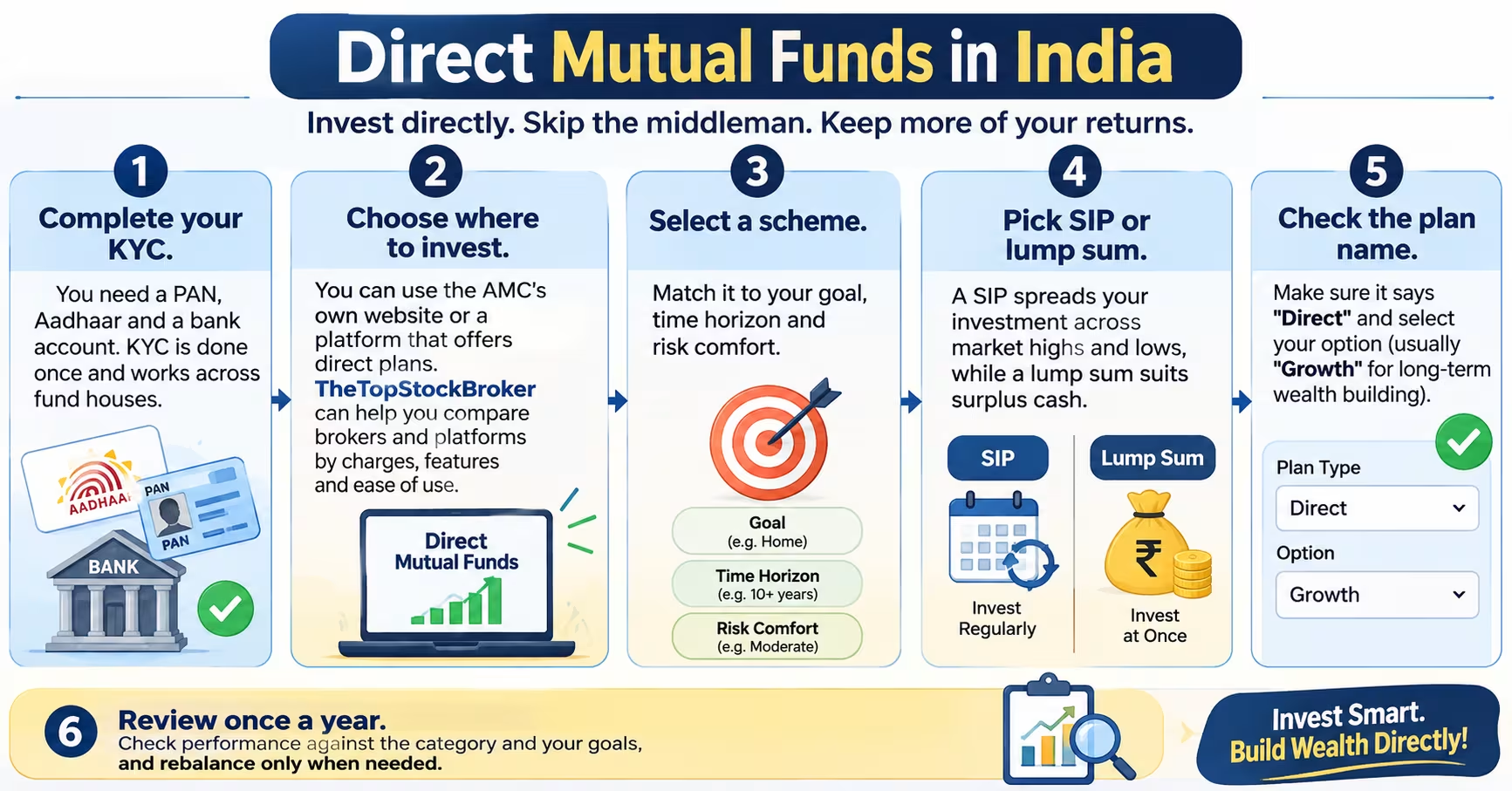
Complete your KYC. You need a PAN, Aadhaar and a bank account. KYC is done once and works across fund houses.
-
Choose where to invest. You can use the AMC's own website or a platform that offers direct plans. TheTopStockBroker can help you compare brokers and platforms by charges, features and ease of use.
-
Select a scheme. Match it to your goal, time horizon and risk comfort.
-
Pick SIP or lump sum. A SIP spreads your investment across market highs and lows, while a lump sum suits surplus cash.
-
Check the plan name. Make sure it says "Direct" and select your option (usually "Growth" for long-term wealth building).
-
Review once a year. Check performance against the category and your goals, and rebalance only when needed.
Direct plans can be taken up if you already have regular plans. Switch is considered redemption and a fresh buy, may involve exit load and capital gains tax. Please review the existing rules or consult a tax expert.
Conclusion
Direct mutual funds provide the same fund but at a lower cost, which can significantly add to your savings over the years. The only drawback is that you have to do the research and make the investment yourself. If you are prepared to do that, direct plans are the ideal option for you.
Want to invest smarter? Check out TheTopStockBroker to compare trustworthy platforms that offer direct mutual funds and start your SIP today.
Disclaimer: Like all types of investments, mutual funds are susceptible to risks. Read all the documents related to the scheme before you invest in one.